
If you have spent any time online talking about relationships, you have probably heard someone say something like:
"I'm anxiously attached with my ex, but securely attached with my current partner."
It can sound like a convenient excuse, a way of avoiding responsibility for old patterns by blaming whoever happens to be standing in front of you.
But the idea itself has real support behind it.
Yes, research suggests that attachment can vary between relationships. You can have broad attachment tendencies that are relatively stable while also experiencing different levels of anxiety, avoidance or security with particular partners.
Attachment style is therefore not quite as fixed or one-size-fits-all as popular quizzes and social media infographics sometimes suggest. In fact, the idea that attachment styles are permanent labels is one of the common misconceptions surrounding attachment theory.

Where the "One True Attachment Style" Idea Comes From
Attachment theory began with the work of John Bowlby, who studied children's relationships with their caregivers, and was developed further through researchers including Mary Ainsworth.
Later researchers such as Kim Bartholomew and Leonard Horowitz helped extend attachment models into adult relationships. Over time, these different research traditions contributed to the familiar language of secure, anxious, avoidant and fearful-avoidant attachment that is widely used today.
The terminology is not always identical across different models. For example, Bartholomew and Horowitz's four-category adult attachment model used the terms secure, preoccupied, dismissing and fearful. You can read more about some of these differences in our explanation of fearful-avoidant and disorganised attachment.
An important idea in Bowlby's theory was that our early relationships help us develop what are called internal working models.
These are expectations about relationships. They can include assumptions about whether other people are likely to be available and responsive, whether closeness feels safe, and whether we ourselves are worthy of care.
These expectations can show considerable continuity over time, which is one reason attachment is sometimes described as relatively stable.
But stable does not mean fixed.
Later relationships and life experiences can also update those expectations. Our attachment patterns may have a starting point, but they are not necessarily a permanent script that every future relationship must follow.
This distinction is important. The trait-based view of attachment is not wrong. Our broader attachment tendencies do matter and can remain surprisingly consistent.
It is simply not the whole picture.
A More Nuanced Picture: Attachment as Layers, Not a Single Setting
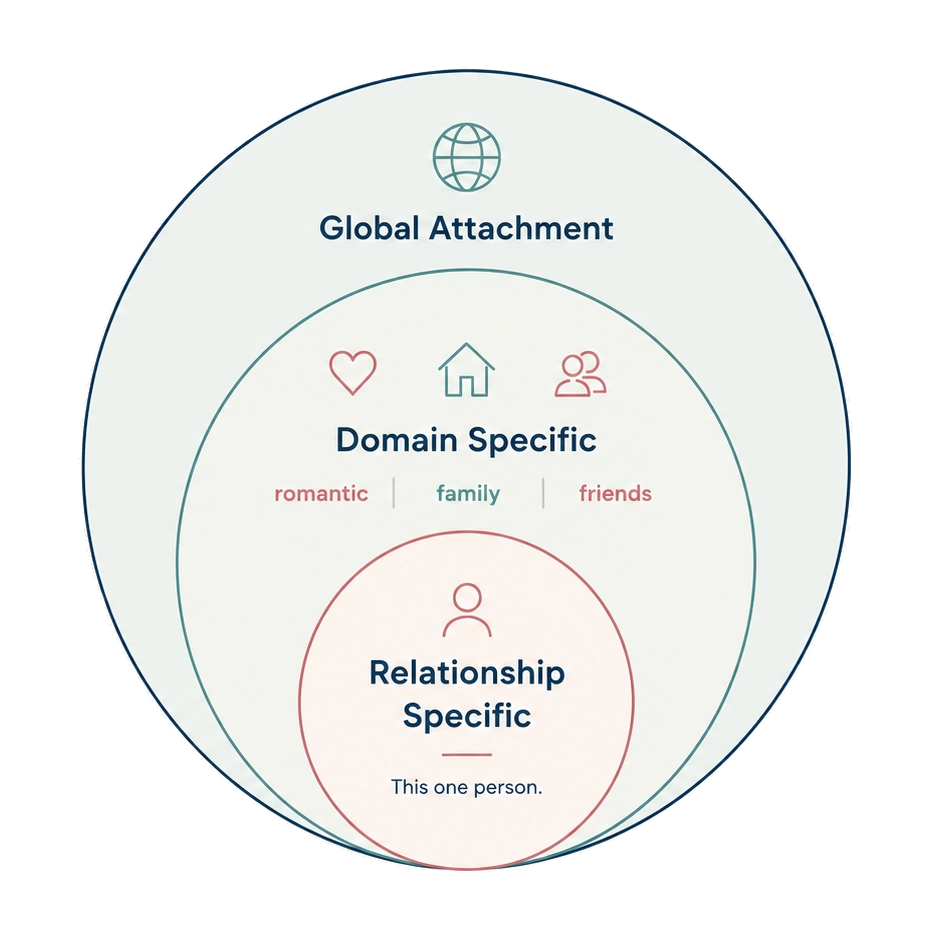
A useful way to think about attachment is not as one permanent setting but as a series of overlapping layers.
Researchers sometimes describe attachment as a hierarchy.
At the broadest level, you can have a general or global attachment orientation: the overall way you tend to approach close relationships.
Within that, you may have patterns associated with particular types of relationships. You might, for example, relate somewhat differently to romantic partners than you do to friends or family members.
And then there is an even more specific level: the attachment pattern that develops between you and one particular person.
Imagine these as nested layers:
- Global attachment: your broad attachment tendencies across relationships.
- Domain-specific attachment: patterns that may be more characteristic of romantic relationships, friendships or family relationships.
- Relationship-specific attachment: the way you experience security, anxiety or avoidance with one particular person.
This matters because your attachment behaviour is not only a reflection of your own history.
It is also influenced by the relationship you are actually in.
A partner who behaves consistently, follows through on promises and responds sensitively when something matters to you can make it easier to feel increasingly secure in that relationship.
A partner who is unpredictable, dismissive or difficult to read may activate anxiety or withdrawal, including in someone who generally feels relatively secure in other close relationships.
That does not mean the partner simply creates your attachment style.
It means attachment develops through an interaction between what you bring into the relationship and what repeatedly happens between the two of you.
What the Research Actually Shows
This is more than an appealing theory.
Researchers can measure people's broad attachment tendencies and compare them with how those same people experience attachment within particular relationships.
The two are related, but they are not necessarily identical.
Someone may have a generally anxious attachment orientation while feeling considerably more secure with one particular partner.
Another person may generally feel secure but experience unusually high anxiety in a relationship characterised by unpredictability or inconsistent reassurance.
This does not make the broader attachment orientation meaningless.
Instead, it suggests there are multiple levels of attachment operating at the same time.
General attachment may tell us something important about the expectations and strategies a person tends to carry between relationships.
Relationship-specific attachment tells us something about what is happening with this person, in this relationship, at this point in time.
Researchers have even developed a measurement tool around this idea.
The Experiences in Close Relationships – Relationship Structures questionnaire (ECR-RS) measures attachment anxiety and avoidance separately across different close relationships, such as relationships with parents, a romantic partner and a best friend.
That is significant because researchers do not have to assume that one single attachment score describes how somebody relates to every important person in their life.
A person can therefore be relatively secure in one relationship while experiencing considerably more attachment anxiety or avoidance in another.
So Why Can It Feel So Different With Different Partners?
Your general attachment tendencies can be thought of as a baseline or starting point rather than a rigid script.
If earlier relationships taught you that closeness was unreliable, you may enter new relationships with a stronger tendency towards anxiety or avoidance.
But each new relationship also provides new information.
Hundreds of apparently small experiences gradually build a picture of whether this particular person is safe to depend upon.
Do they respond when you reach out?
Can disagreements be repaired?
Do they disappear when things become difficult?
Can you express a need without being mocked or punished?
Do their words and actions broadly match?
Over time, those experiences matter.
A relationship that repeatedly demonstrates safety may help someone feel increasingly secure within it, even if their broader attachment tendencies have not completely changed.
In some cases, sustained corrective relationship experiences may also contribute to longer-term changes in attachment. This is sometimes discussed in relation to earned secure attachment, where someone develops a more secure way of relating despite earlier experiences that did not provide consistent security.
The opposite can happen too.
Someone who generally feels fairly secure may become increasingly anxious in a relationship where affection is repeatedly withdrawn without explanation or where the future of the relationship constantly feels uncertain.
Likewise, someone may become more withdrawn when repeated attempts at vulnerability are met with criticism, hostility or dismissal.
None of this means attachment is simply something another person does to us.
But it does mean that relationships provide ongoing experiences that can strengthen or challenge our existing expectations.
Your Partner Matters, But They Do Not Determine Your Attachment Style
There is an important distinction here.
Saying that attachment can be relationship-specific does not mean that a partner simply causes your attachment style.
You still bring your own expectations, sensitivities, history and coping strategies into a relationship.
Your partner brings theirs.
What develops between you is influenced by both.
This is why two people can react differently to similar circumstances, and why changing partners does not automatically make long-standing attachment patterns disappear.
A supportive and responsive relationship may make it easier for someone to feel secure.
An inconsistent relationship may make existing fears much more noticeable.
But context should help us understand our behaviour, not remove responsibility for it.
This is particularly important because attachment language can sometimes become a convenient way to justify behaviour:
"I did that because I'm anxious."
Or:
"I can't talk about feelings because I'm avoidant."
Attachment patterns can help explain why certain reactions feel powerful or automatic, but explanation is not the same as excuse.
We explore this distinction in more detail in Are Attachment Styles Real or Just an Excuse for Bad Behaviour?.
A Secure Partner Can Help, But They Cannot Do All the Work
It is tempting to hear all of this and conclude that the solution is simply to find a secure partner.
There is some truth hidden inside that idea.
A stable relationship with someone who communicates clearly, responds reliably and is able to repair disagreements may provide experiences that make security easier.
But even a very secure partner cannot permanently compensate for patterns that another person is unwilling to examine.
Someone with high attachment anxiety may still need to learn how to tolerate uncertainty without repeatedly seeking reassurance.
Someone with stronger avoidant tendencies may still need to practise remaining emotionally present when closeness feels uncomfortable.
A healthy partner can create conditions in which change becomes easier.
They cannot make those changes on somebody else's behalf.
This is also why relationships between people with different attachment tendencies are not automatically doomed.
Understanding the pattern gives both people an opportunity to respond differently rather than simply repeating the same cycle.
What About the Anxious-Avoidant Dynamic?
The relationship-specific nature of attachment can become particularly noticeable when someone with stronger attachment anxiety becomes involved with someone who tends towards avoidance.
As the anxious partner senses distance, they may seek additional contact or reassurance.
The avoidant partner may experience that pursuit as pressure and withdraw.
The withdrawal increases the anxious partner's sense of danger, leading them to pursue even more strongly.
Both people can end up behaving in ways that seem much more extreme than they do in other relationships.
The anxious partner may say:
"I've never felt this insecure with anyone before."
The avoidant partner may say:
"I've never felt this suffocated in a relationship before."
Both statements may genuinely be true.
That does not necessarily mean either person has suddenly developed a completely different personality.
It may mean that their attachment strategies are interacting in a way that repeatedly activates each other's insecurities.
Understanding this can be useful because it moves the conversation away from:
"Which one of us is the problem?"
and towards:
"What keeps happening between us?"
That is often a much more productive question.
Can Your Attachment Style Actually Change?
There are really two slightly different questions here.
The first is:
Can you feel differently attached to different people?
Yes.
The second is:
Can your broader attachment tendencies change over time?
Again, the answer appears to be yes, although these changes may be slower.
Attachment tends to show a degree of stability, but it is not immutable. Significant relationships, therapy, personal insight and repeated experiences of safe connection can all potentially contribute to change.
We explore this in more detail in Can Your Attachment Style Change?.
This is one reason it can be misleading to treat the result of an attachment quiz as a permanent identity.
A quiz gives you a useful snapshot of current patterns.
It is not a lifetime diagnosis.
What This Means If You Notice It in Yourself
If you felt highly anxious with one partner but noticeably calmer with another, you do not need to dismiss that experience.
Likewise, if one relationship seems to bring out a more withdrawn version of you than previous relationships did, it is worth paying attention.
Rather than asking only:
"What is my attachment style?"
you might ask several questions.
What patterns do I notice across most of my relationships?
These may tell you something about your broader attachment tendencies.
What feels different about this particular relationship?
Does your partner communicate differently? Are they more or less predictable? Do you trust them? Can conflict be repaired?
What happens to me when I feel insecure?
Do you pursue, repeatedly seek reassurance, shut down, become critical or pull away?
What does my partner do in response?
Attachment patterns often become clearer when we look at the cycle rather than one person's behaviour in isolation.
Do I feel more secure over time, or less?
Healthy relationships will still contain insecurity and conflict, but over time there should usually be more evidence that problems can be survived and repaired.
These questions tell us far more than simply applying a label.
Attachment Style Is a Pattern, Not an Identity
One of the risks of attachment theory becoming so popular is that the labels can begin to sound like personality types.
Someone becomes an anxious.
Another person becomes an avoidant.
Another becomes a secure.
But real people are not attachment categories.
Attachment describes patterns around closeness, dependence, rejection and emotional safety.
Those patterns can be powerful, but they exist alongside personality, values, emotional maturity, life experience, communication skills and the particular relationship somebody is currently experiencing.
That is also why attachment theory myths can become unhelpful when they turn flexible psychological concepts into rigid rules.
Knowing your likely attachment style can still be extremely useful.
It can help you recognise why particular situations affect you so strongly.
It can help you notice patterns you repeat.
And it can give you language for needs or fears that previously felt confusing.
But the purpose of the label is to understand the pattern.
It is not to become the pattern.
So, Can You Have a Different Attachment Style With Different Partners?
Yes, but with an important qualification.
You probably do not completely reinvent your attachment system every time you begin a new relationship.
Most people carry broader expectations and tendencies with them.
But those tendencies interact with each particular relationship.
You can therefore feel significantly more anxious, avoidant or secure with one partner than another.
A supportive relationship may gradually give you more evidence that closeness is safe.
A chaotic or unpredictable relationship may activate fears that rarely appear elsewhere.
And sometimes a particular pairing brings out patterns in both people that neither experiences as strongly in other relationships.
Understanding this should not become a way of blaming our partners for everything we feel.
Nor should attachment theory be used to argue that every problem comes from childhood and has nothing to do with the relationship we are actually living in.
Both matter.
You bring an attachment history into the relationship, and then the relationship creates a history of its own.
Perhaps that is the most useful way to think about it.
Your attachment style gives you a starting point.
It does not necessarily tell us exactly how every relationship will unfold.
If you would like to explore your own patterns, take our attachment style quiz and consider the result as a starting point for understanding how you tend to experience closeness, reassurance and independence in relationships.